Purpose
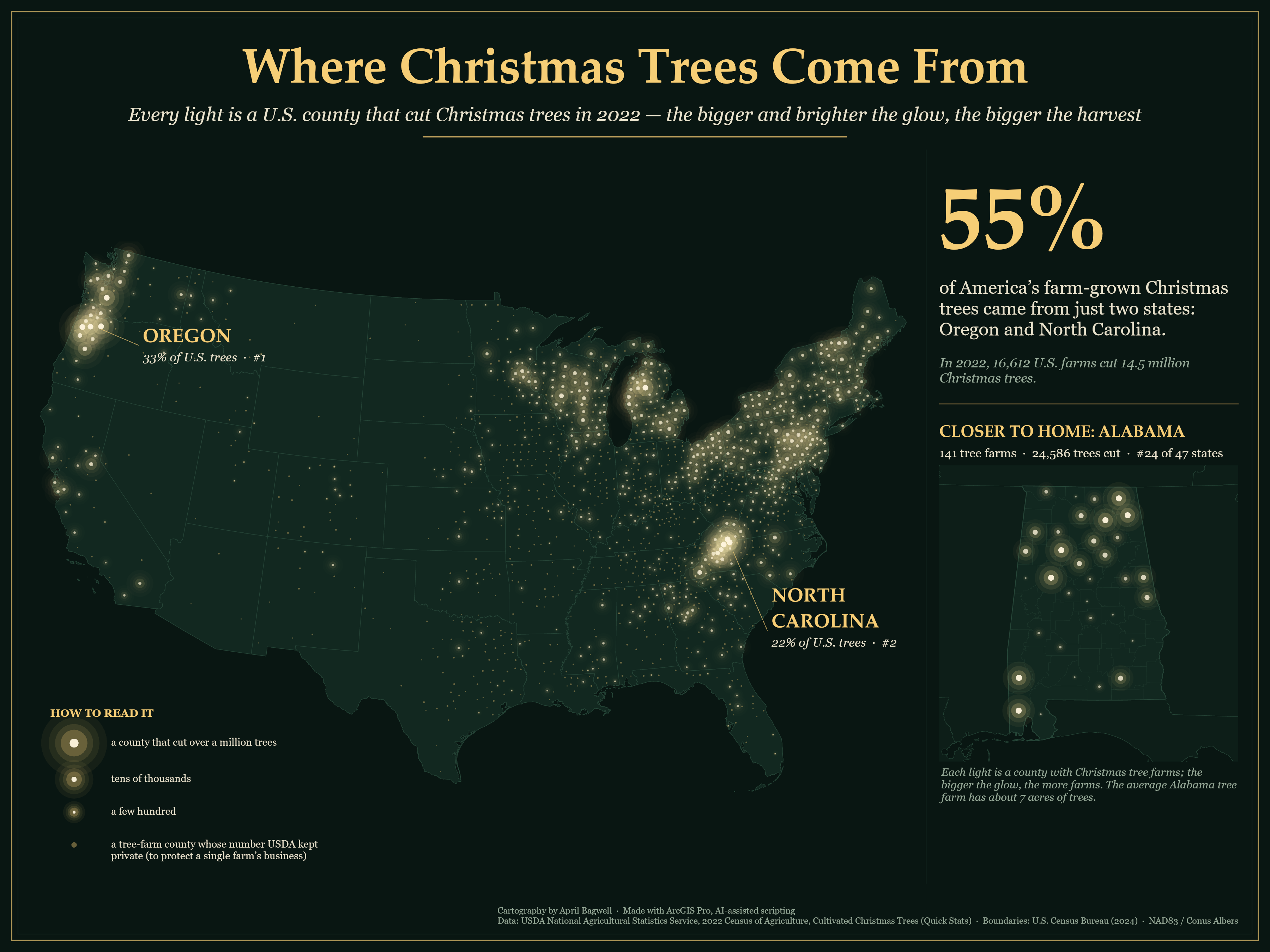
About 14.5 million real Christmas trees were cut on American farms in 2022. This map draws them as string lights on an evergreen night: every county that cut Christmas trees glows, and the bigger and brighter the light, the bigger the harvest. More than half of those trees came from just two states. Oregon grew 33% of them and North Carolina 22%, two bright clusters on opposite sides of the country, with a busy band of smaller growers across Michigan, Wisconsin, Pennsylvania and New England. Closer to home, the Alabama inset shows the state’s 141 tree farms, which cut 24,586 trees in 2022 (24th of 47 states). The average Alabama tree farm has about 7 acres of trees.
Data
USDA National Agricultural Statistics Service, 2022 Census of Agriculture, Cultivated Christmas Trees (Quick Stats): trees cut, acres in production and farms, by county, state and nation. Boundaries: U.S. Census Bureau Cartographic Boundary files (2024).
Tools
ArcGIS Pro and Python (arcpy), with AI-assisted scripting.
Process
An arcpy script downloads the Christmas tree numbers from the USDA Quick Stats service and places a point at the center of every county with Christmas tree farms. Each light is built from stacked layers: faint halo rings, a soft glow and a warm-white core. The halos use Screen blending, so they brighten where they overlap, and the smallest growers are dimmed so the biggest ones shine brightest. USDA withholds the trees-cut number for about a third of tree-farm counties (580 of 1,580) to protect individual farms’ business. Those counties still appear as dim embers, using farm counts, which USDA does not withhold. The 55% headline, the state shares and the Alabama numbers are all worked out from the data, not typed in by hand.

